Bypass diodes, strings and optimisers: what partial shading really costs
Shade on one module is not a problem of the module but of the string. Understand that and you decide correctly between standard wiring and optimisers, saving either money or trouble.
Inside the module
A module has 108 to 144 cells in series, split into three groups, each with a bypass diode. When shade falls on one cell it delivers less current, and because all cells of the group must carry the same current, the shaded cell slows the whole group. At some point the bypass diode opens and bridges the group: the module loses a third of its power instead of failing entirely, and the shaded cell does not overheat.
Inside the string
8 to 20 modules hang in series on the inverter. Again: one current for all. A module delivering only 40 % current because of shade pulls the whole string down to 40 %, unless its bypass diodes bridge it. The inverter searches for the best operating point (MPP) but under partial shading often finds only a compromise. In practice: a chimney shadow on one module can cost 10 to 20 % of the string while it lies there.
Example from PV-Schatten
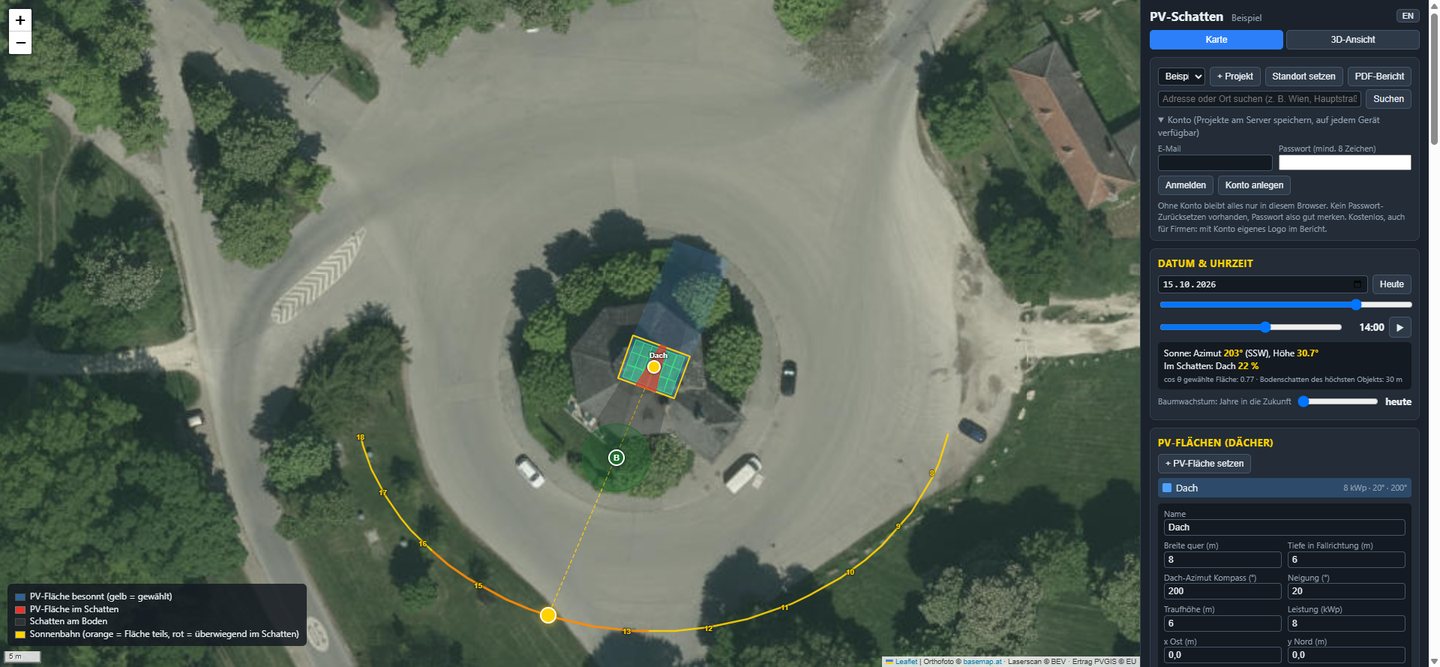
Module layout on a 48 m² area with 18 modules in 3 rows, 18 m spruce to the south: the annual per-module calculation gives 4 % loss of direct irradiance in the “each module on its own” model (optimisers) and 10 % in the “one string per row” model. The bottom row is hit hardest but only drags down its own row, because the tool assumes one string per row. With all three rows in one string, 10 % quickly becomes 15 %.
What helps, ordered by cost
- Change the layout (free): take modules out of the shaded zone; 16 free modules beat 18 of which 3 sit in winter shade.
- Plan strings by shade (free): shaded modules in their own string or on their own MPP input. Rows across the direction of the shadow.
- Half-cut modules (small surcharge): two halves in parallel, shade on one half halves the loss instead of tripling it.
- Power optimisers (SolarEdge, Tigo, 50 to 80 € per module): each module works at its own point; per-module monitoring included. More electronics on the roof, more possible points of failure.
- Micro-inverters (Enphase, Hoymiles, 100 to 200 € per module): like optimisers, but each module delivers AC directly. Expensive for large systems, ideal for small, fragmented roofs.
When optimisers do not pay off
With far shading (mountains, hills), with uniform shading of whole rows, and on free south-facing roofs. There they bring 0 to 2 % and cost 1,000 € and more. Optimisers are a tool against hard, uneven near shading, not against poor sites.